


Welcome to AI and Our Faith! This is a monthly newsletter in which I offer my best insights and reflections on the ways in which theological thinking can inform the ethical (dis)use of artificial intelligence (AI). Look out for new releases on the 15th of each month!
When some were speaking about the temple, how it was adorned with beautiful stones and gifts dedicated to God, [Jesus] said, “As for these things that you see, the days will come when not one stone will be left upon another; all will be thrown down.” —Luke 21:5–6
It wasn’t until about a month ago, when I read about the history of Herod’s Temple in preparation for a sermon, that I had any idea of its scale and opulence. I came across a passage by the Roman-Jewish historian Josephus describing the Temple’s facade, which I find immensely helpful for visualizing what Jesus was speaking about:
Now the outward face of the temple in its front wanted nothing that was likely to surprise either men’s minds or their eyes; for it was covered all over with plates of gold of great weight, and at the first rising of the sun, reflected back a very fiery splendour, and made those who forced themselves to look upon it, to turn their eyes away, just as they would have done at the sun’s own rays. But this temple appeared to strangers, when they were coming to it at a distance, like a mountain covered with snow; for, as to those parts of it that were not gilt, they were exceedingly white. On its top it had spikes with very sharp points to prevent any pollution of it by birds sitting upon it. Of its stones some of them were forty-five cubits [~20 m] in length, five [~2.3 m] in height, and six [~2.7 m] in breadth.1
Seeing it put this way, it doesn’t seem so surprising that the people around Jesus were so caught up in admiring the architecture. Herod’s building project seems to have had its desired effect, being so visually astonishing that people are distracted from seeing how God is at work in the world. I should point out that just before this exchange, Jesus highlighted the wealth disparities of ancient Judea by contrasting a poor widow who put two copper coins into the temple treasury with the rich who put in their own (presumably lavish) gifts. But the people would rather talk about beautiful stones!
Then I ask myself, who are we to judge? Aren’t the people of our generation caught up in admiring the works of human hands? Gold and stones; machinery and circuits; isn’t it all the same? Will the day not come once again when “all will be thrown down”?
For the Lᴏʀᴅ of hosts has a day
 against all that is proud and lofty,
 against all that is lifted up and high;
against all the cedars of Lebanon,
 lofty and lifted up;
 and against all the oaks of Bashan;
against all the high mountains
 and against all the lofty hills;
against every high tower
 and against every fortified wall;
against all the ships of Tarshish
 and against all the highly prized vessels. —Isaiah 2:12–16
The stones of Herod’s Temple were certainly durable; left alone, they might have endured for generations. From a worldly point of view, it is understandable that people would trust in stones and machines, things that do not die—or, for that matter, live. But the durability of stone belies its vulnerability. Stones and the things we build from them are not eternal. They are subject to time and chance, just as we are.
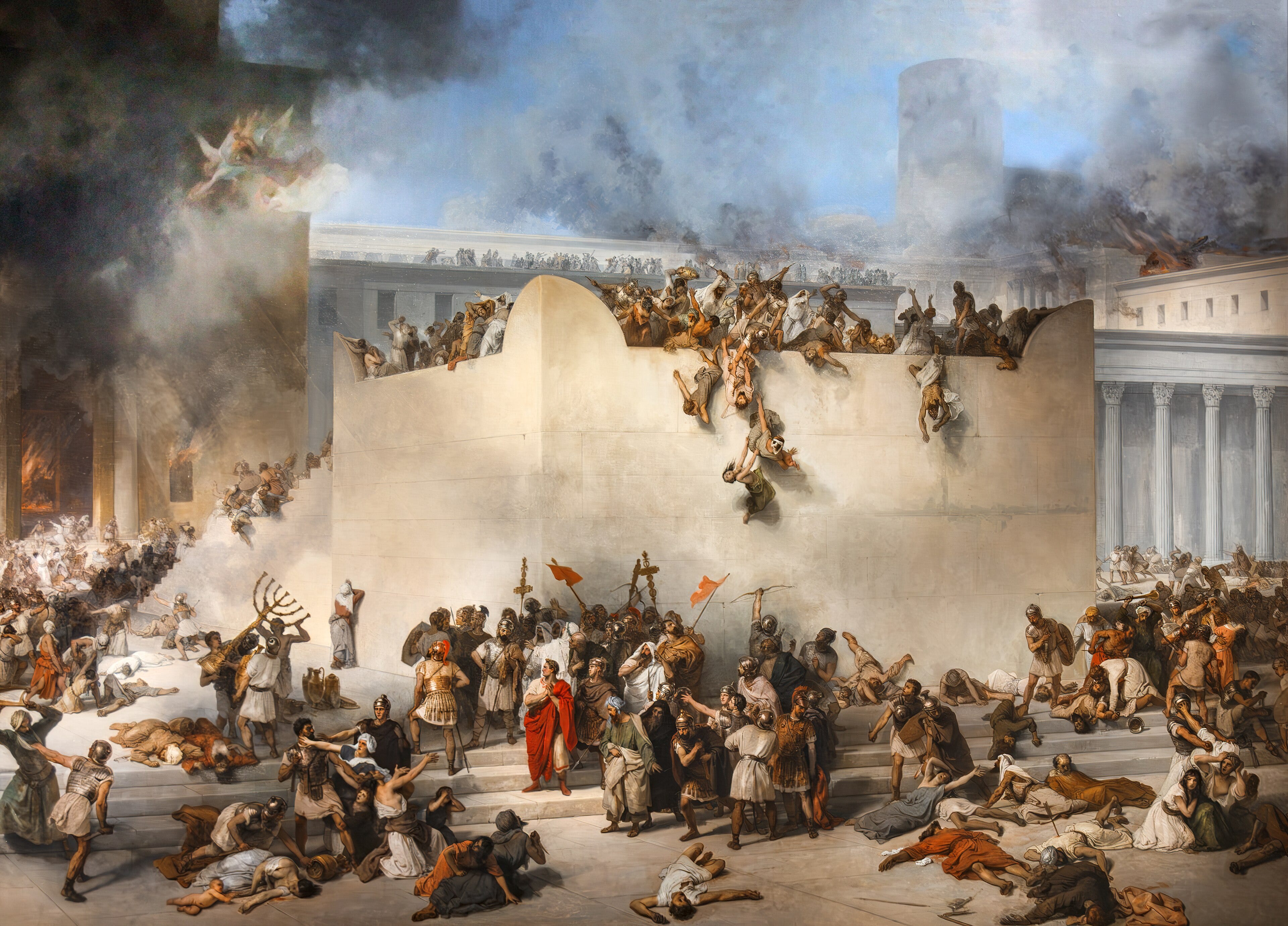
_La_distruzione_del_tempio_di_Gerusalemme_-Francesco_Hayez_-_gallerie_Accademia_Venice.jpg)
The people of ancient Judea learned this lesson the hard way when, in the aftermath of the First Jewish-Roman War, the Romans destroyed the Temple and looted its precious treasures, including the Menorah. The four Gospels, written in the years and decades after the Temple’s destruction, speak to the lessons of this bitter experience:
The Passover of the Jews was near, and Jesus went up to Jerusalem. In the temple he found people selling cattle, sheep, and doves and the money changers seated at their tables. Making a whip of cords, he drove all of them out of the temple, with the sheep and the cattle. He also poured out the coins of the money changers and overturned their tables. He told those who were selling the doves, “Take these things out of here! Stop making my Father’s house a marketplace!” His disciples remembered that it was written, “Zeal for your house will consume me.” The Jews then said to him, “What sign can you show us for doing this?” Jesus answered them, “Destroy this temple, and in three days I will raise it up.” The Jews then said, “This temple has been under construction for forty-six years, and will you raise it up in three days?” But he was speaking of the temple of his body. —John 2:13–20
God’s temple is not made of lifeless stone, but human flesh. God’s temple lives, and moves, and breathes, and suffers, and dies, in order to live again. From a worldly point of view, it seems that stones will outlast flesh. But we know very well that although the stones are enduring, they are not eternal! If we want to hope in something eternal, we must not look towards “houses made with human hands,”2 but instead towards God’s promise of the resurrection, sealed by the One who is true God and eternal life.3
Do not court death by the error of your life
or bring on destruction by the works of your hands,
because God did not make death,
and he does not delight in the destruction of the living. —Wisdom 1:12–13
But in our day and age, and perhaps in every day and age, those who hold the levers of economic and political power grasp for the secrets of immortality in the most absurd places, instead of trusting in the promise of God who is Faithful and True.4 Just the other day I read Jasmine Sun’s latest dispatch from Silicon Valley, highlighting how (I wish I was joking) the tech bros of Silicon Valley are injecting themselves with grey market Chinese peptides and resurrecting Victorian racialist pseudoscience. The ridiculousness of it, I think, slightly undercuts how abominable it actually is: to treat yourself like a lab rat, and your body like a machine, and for what purpose? To stave off, for a few years, a bodily death which must surely come? What madness!
And this is just the tip of the iceberg. As Émile P. Torres points out, the worlds of transhumanism and Christian nationalism are increasingly coming together. On first glance this might seem surprising, but on closer inspection we see that these ideologies have deep structural similarities: eschatological promises of weal and woe; the idolatrous exaltation of human power in the form of machines and nations. Some transhumanists even refer to a theoretical artificial superintelligence (ASI)—an AI whose general capabilities greatly exceed those of humans—as a godlike being.
But God does not dwell in houses made by human hands, whether those houses are made of stones, or of semiconductors! God dwells in each and every one of us. For as St. Paul wrote to the Corinthians, “Do you not know that you are God’s temple and that God’s Spirit dwells in you? If anyone destroys God’s temple, God will destroy that person. For God’s temple is holy, and you are that temple.”5 What is the good news but this: that just as God raised the temple of Jesus’ body from the dead, we too are temples of God, and God will raise each of us from the dead in the fullness of time?
So in this new year, let us ask ourselves, where shall we direct our efforts? Let us “build our hopes on things eternal,” remembering that of all things, only love never ends.6 And when all is said and done God will not ask us whether we spent enough time admiring the architecture, but whether we have fed the hungry, quenched the thirsty, welcomed the stranger, clothed the naked, and visited the prisoner.7 Shall we not be faithful and take up God’s call to have mercy when the ruling powers will not?
Thank you for reading my first post of the year. I’m hoping to keep my publishing streak going throughout the year. Please consider sharing my work with anyone who might want to read it!
Flavius Josephus, “The Wars of the Jews,” in Complete Works of Josephus, vol. 4, trans. Siwart Haverkamp (Bigelow, Brown & Co., 1900), 211–212, https://archive.org/details/completeworksofj19004jose.
Acts 7:48.
1 John 5:20.
Revelation 19:11.
1 Corinthians 3:16–17.
1 Corinthians 13:8.
Matthew 25:31–46.