

But I want to know about after the press conference, when everyone has gone home
Some reflections on the papal encyclical Magnifica humanitas

Welcome to AI and Our Faith! This is a monthly newsletter in which I offer my best insights and reflections on the ways in which theological thinking can inform the ethical (dis)use of artificial intelligence (AI). Look out for new releases on the 15th of each month!
We hear so much about the healing, but I want to know
about after the miracle, when everyone has gone home.
The shape of the blankets left behind the body. The woman
who comes to shake them out and make the bed, her arms
strong from lifting the body that now walks.

⋮

Why isn't she the miracle? And those sisters in the kitchen,
banging around the pots, the spoons with a joy they'd never
felt before. Joy a new word in this world that could bring
what they loved back. Behind every resurrection: dailiness.
— Sophia Stid, “Selvedge”
Last month, the Vatican published Pope Leo XIV’s encylical letter, Magnifica humanitas, subtitled “On Safeguarding the Human Person in the Time of Artificial Intelligence.” Over the last few weeks, a cottage industry of commentary has emerged around the encyclical, coming from both religious and secular perspectives. Coming to it as an ecumenically-minded Protestant, I think that Magnifica humanitas is a stirring defense of human dignity in the face of dehumanizing technical forces. It will certainly be a touchstone for Christian social ethics, both now and well into the future.
There is much that could be said about Magnifica humanitas—I am sure that it will be the subject of entire dissertations over the next ten or twenty years. I have been mulling over whether I had anything worth saying about the encyclical, and in the last few days I realized that I wanted to highlight its pastoral guidance for everyday life. These ideas are found in the section with the heading “We can all do our part.” This section has actually gotten a lot of traction in both social and traditional media… mostly because it quotes The Lord of the Rings, and “The Pope quotes Gandalf” makes for a good headline. But it’s well worth reading the quote in its original context:
At this point, however, a subtle temptation may emerge, namely the thought that the problems are too big and we are too small, and that our choices, therefore, cannot make a difference. This is a polite form of resignation, often disguised as realism. Certainly, not everyone has the same power to make a difference. There are those who govern, make investment decisions, lead institutions, conduct research, educate, produce or provide information, and then there are those who only seem to live their daily lives. Yet, no one is without responsibility. [emphasis added] We all have our own areas for action, and it is precisely there — and nowhere else — that we must choose whether to fuel the mentality of force (even if only through indifference, cynicism, lies or hatred), or to preserve the mindset of peace (with truth, moderation, closeness and care).
The twentieth-century Catholic author J.R.R. Tolkien, in the words of a protagonist in one of his novels, described our responsibility in this way: “It is not our part to master all the tides of the world, but to do what is in us for the succour of those years wherein we are set, uprooting the evil in the fields that we know, so that those who live after may have clean earth to till.” The civilization of love will not arise from a single or spectacular gesture, but from the sum total of small and steadfast acts of fidelity that serve as a bulwark against dehumanization. [emphasis added]
For me, this passage raises this question: Who actually does the work of AI ethics? Is it the in-house philosophers of the frontier AI labs? The policymakers in Washington and Beijing? Wannabe public intellectuals like myself who write online newsletters?
What this encyclical says is that everyone has a part to play in AI ethics. Now, someone might say that I am stretching Pope Leo’s words, because what he says here is that everyone is responsible for building the “civilization of love,” not contributing to “AI ethics.” Surely one could build the civilization of love without being an AI ethicist.
If we understood “ethics” in a narrow sense, as an intellectual discipline that involves making formal arguments about what humans should do, then this objection would make perfect sense. But, I think that it is quite wrong to make “ethics” the preserve of a certain kind of professional intellectual, who makes a living off of making “ethical” arguments. We should all be “ethicists,” because we should all be invested in learning about what is the right thing to do! It’s helpful to know that we get the word ethics from the Greek word е̄thika, an adjective that means “pertaining to character.” If you have ever wondered, “What sort of person should I be?” you have worked on “ethics.” And if you have ever asked yourself, “What sort of person should I be ‘in the time of artificial intelligence’?” I would say that you have worked on “AI ethics.” Not all of us are going to write policy, or do research, or give pastoral guidance, but all of us need to learn how to “do justice, love kindness, and walk humbly with our God” in this age.
So where should we start? One of my favorite passages from Magnifica humanitas is about the value of spending time together. Pope Leo writes, “Indeed, dialogue is an ordinary part of human life and does not only concern relations between States. It involves acquiring an attitude that seeks to forge bonds of fraternity built on listening, an open demeanor, making time for each other and even wasting time together. For if we experience authentic encounters with others, with those who are different, strangers and migrants, it becomes much more difficult even to imagine war.”1
If we want to build a world where people are valued, not merely in terms of the labor that they can provide, but in terms of who they are, we need to show up for one another. I think that it is profound that Pope Leo identifies even the act of “wasting time together” as an act of dialogue. It makes perfect sense to me that everyone is called to the simple act of making time for one another to build up the “civilization of love,” because so much of the demand for generative AI comes out of the disrupted social fabric of the loneliness epidemic. Would so many people be using AI chatbots as sources of simulated companionship and emotional support if they were confident that people in their lives would make space to hear their concerns? We cannot make real progress on “AI ethics” without addressing upstream issues like social alienation.
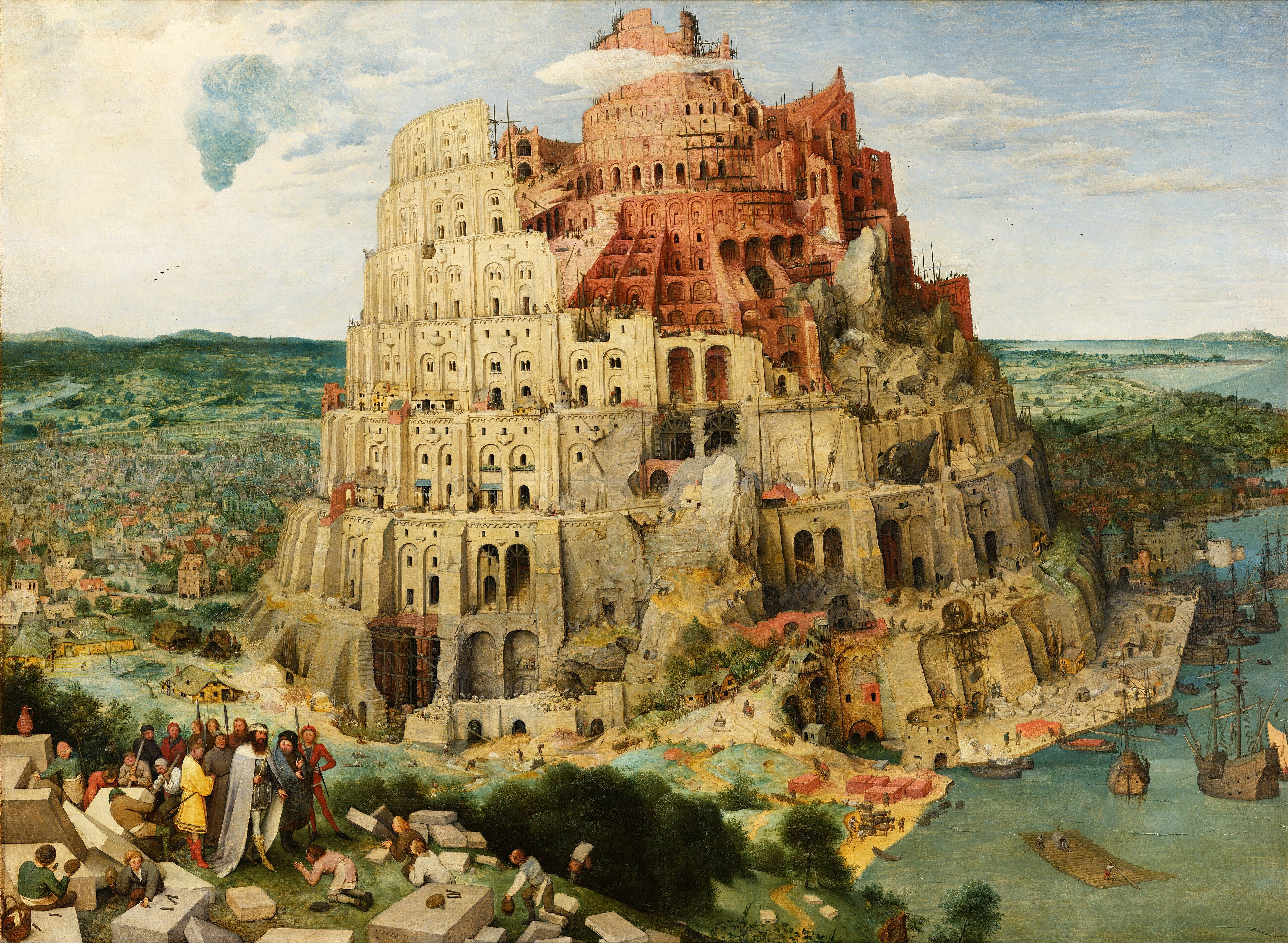
The so-called effective altruist movement claims that people should gravitate towards certain types of careers (unsurprisingly, their list includes such causes as “earning to give” and “effective altruism fieldbuilding”) on the basis that these careers have higher impact than others. This kind of reasoning, grounded in a reductivist form of consequentialist ethics, assumes that every possible human action can be evaluated on the same scale. It is an elitist model of ethics, which invites humans to look upon all of creation as if they were God and bend it into the desired shape. This mirrors the trajectory of the Tower of Babel, which is a centering image in Magnifica humanitas.2
_-_Google_Art_Project_-_edited.jpg)
In contrast to Babel, Pope Leo offers the story of Nehemiah, who rebuilt the walls of Jerusalem after the Israelites returned from their exile in Babylon. Magnifica humanitas recounts the story of Nehemiah in this manner: “[Nehemiah] did not impose solutions from above. He convened the families, assigned each of them a section of the wall to rebuild, listened to their concerns, coordinated their efforts and addressed any opposition. The narrative shows how the city is reborn, not through the initiative of one man, but through the shared responsibility of all: men, women, priests, artisans, heads of households and young people all play a part. It is an undertaking with God at the center, which rebuilds relationships before rebuilding with stones.”3
Pope Leo’s interpretation of Nehemiah reflects the principle of subsidiarity from Catholic social teaching: that “the role of individuals, families, local communities, and intermediary organizations should not be supplanted by higher-level authorities.” When society is organized on the basis of subsidiarity, decisions are made “at the closest level possible to the persons involved, thereby fostering community life and avoiding people being presented with decisions that have already been taken.”4
I think that all Christians should embrace subsidiarity as part of their social ethics, and especially when it comes to AI ethics. Subsidiarity opposes top-down technocratic schemes for reshaping the world (what the political anthropologist James C. Scott once termed “high modernism”) in favor of participatory processes that embrace social complexity and the multiplicity of human perspectives. Subsidiarity reminds us that all of us have a role to play in the world’s great problems, even in our dailiness.
At the beginning of this essay, I quoted the poem “Selvedge,” which someone once shared with me after Easter during a time in my life when I was really struggling. This poem invites us to look at the resurrection story in a different light—not just as a one-and-done event, but as a story which takes place among everyday acts of mercy. Magnifica humanitas teaches us that “small and steadfast acts of fidelity” culminate in “a bulwark against dehumanization,” and the Gospels testify to such acts. The story of the Cross is incomplete without the stories of Simon of Cyrene carrying the cross,5 Joseph of Arimathea retrieving Jesus’s body,6 and the women who followed Jesus preparing spices and ointments for the burial.7 Behind every resurrection: dailiness.
We hear so much about the encyclical, but I want to know about after the press conference, when everyone has gone home…
Paragraph 220.
Paragraph 7.
Paragraph 8.
Paragraphs 68–70.
Luke 23:26.
Luke 23:50–53.
Luke 23:55–56.
Beautifully written, Weija. Your beginning quote really struck me. It reminds me of Brother Lawrence's spirituality, Saint Teresa of Avila"s “the Lord walks among the pots and pans,” or the Kitchen Prayer. The Pope's recommendations are doable for everyone: to love God and our neighbor (not that that is easy!), to lean hard into our humanity. This gives me hope.