

Work can be joyous
Reflections on coding ebooks in the age of Claude Code

Welcome to AI and Our Faith! This is a monthly newsletter in which I offer my best insights and reflections on the ways in which theological thinking can inform the ethical (dis)use of artificial intelligence (AI). Look out for new releases on the 15th of each month!
For almost six years, I’ve been contributing to Standard Ebooks, a volunteer project which (in our own words) “produces new editions of public domain ebooks that are lovingly formatted, open source, free of U.S. copyright restrictions, and free of cost.” By my count, I’ve produced nearly fifty ebooks over the years, including both heavy-hitters like The Idiot and much more obscure titles like Ameen Rihani’s poetry.1 These days you will find my photo on our masthead, because I am a member of the editorial team, which is responsible for overseeing the projects of other contributors.
My work as a volunteer is time-consuming. I would guess that on a given week, I spend between five and ten hours on the site, whether I am working on my own ebook projects or providing feedback on others’ projects. But my work is freely chosen and freely given, and at this point, I could not imagine my life without it. I do not and will not regret a single second of my life that goes into making a beautiful ebook.
In fact, I started contributing to Standard Ebooks at a difficult period in my life. During the fall of 2020, about half a year into the Covid pandemic, I was struggling to make sense of what I was doing with my life as I was holed up alone in my studio apartment in Palo Alto, working remotely in my software engineering role. Day in and day out, I dragged myself to my laptop to do my work and make my paycheck, but why? Why was I working so hard to get by in a world that felt so stifling and bleak?
It turned out that the answer was Leo Tolstoy. Once when I was young and still in middle school, I stumbled upon his short story, “How Much Land Does a Man Need?” It was the first time a piece of classic literature really captured my attention, and I never quite forgot about it because years later, in 2019, it somehow occured to me that I wanted to read the story again and rekindled my interest in Tolstoy’s stories. To a great extent, I credit Tolstoy with my conversion to Christianity. I am not sure if I would have ever embraced my Christian faith without the help of Tolstoy’s short stories, which have done much to help me see the beauty of loving one’s neighbor.
So, after I started contributing to Standard Ebooks, it felt very natural for me to work on a digital anthology of all of Tolstoy’s short stories.2 When I began the project, I had little idea of just how much work the project would actually involve. There are about a hundred English translations of Leo Tolstoy’s short stories which have gone out of copyright in the United States, and together they add up to about 650,000 words, which is almost a hundred thousand words longer than the entirety of War and Peace.
You might be wondering how much time this took. The truth is, I don’t really know myself, but in some sense it was less than you might have imagined. I finished the collection in about half a year, because I was putting a considerable portion of my free time into the project. The pandemic gave me very little else to do and the project gave me a sense of being part of something much larger than myself. Years later, I still consider it to be one of my life’s greatest achievements. As far I know, it was the first time anyone compiled all of Tolstoy’s short stories into a free and open source ebook.
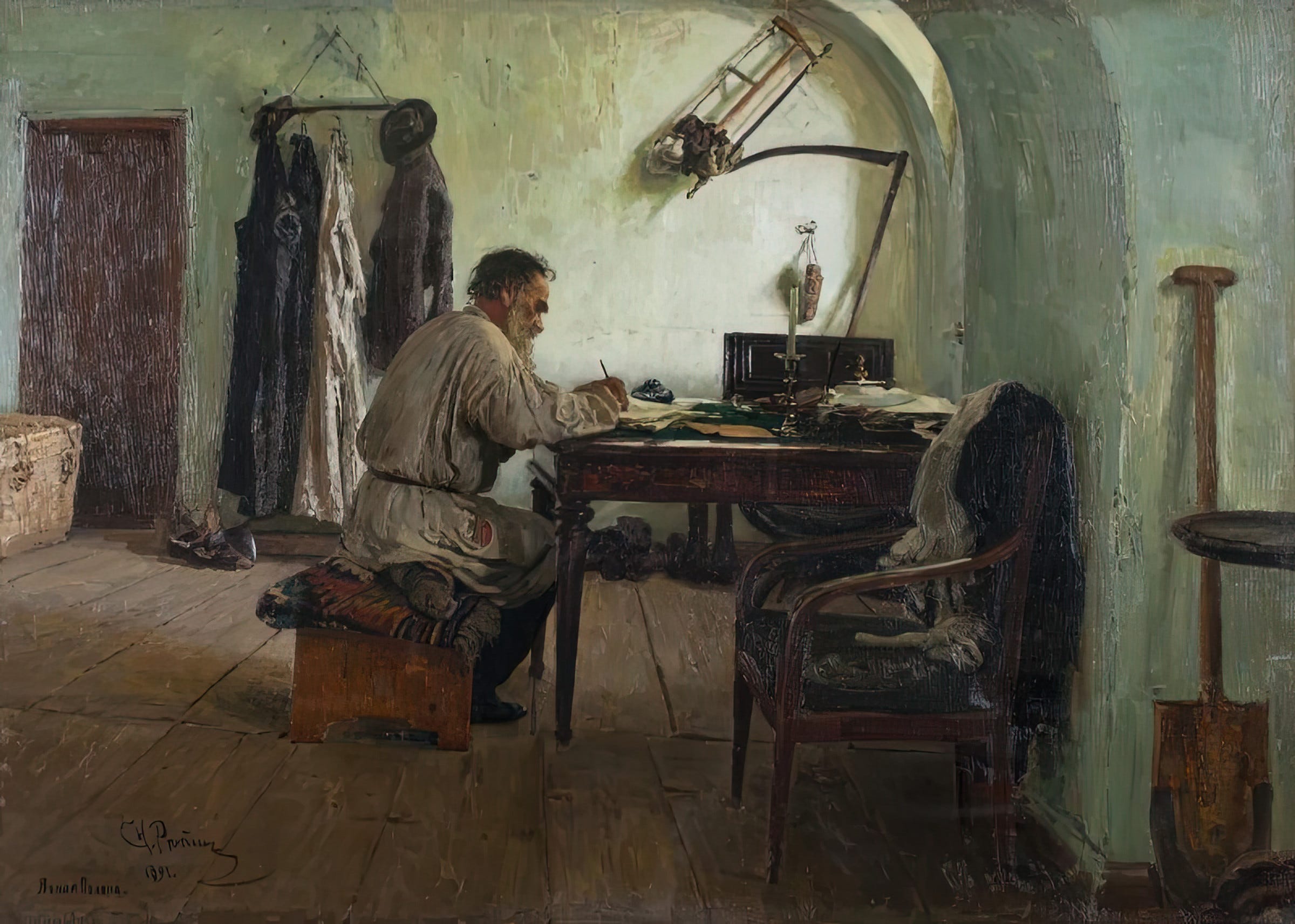
Now, early on during my time as a Standard Ebooks contributor, it occured to me that, on some level, the work we were doing was not that complicated and that in the nearish future, it might be possible for an AI system to do our work from end to end. ChatGPT had not yet come out yet, but I was vaguely aware of LLMs because I had spent some time playing around with AI Dungeon, a text-based game built on GPT-2, back when OpenAI was an obscure nonprofit better known for training Dota 2 bots.
I have never used Claude Code or any other AI coding harness before, but I suspect that with the right configuration (i.e. creating the right skills), it should be possible to have Claude Code produce an ebook from end to end with minimal human intervention. There are some aspects of producing an ebook, like choosing a cover and writing a description that can’t (or shouldn’t) be delegated to AI, but in principle, I would guess that I could get Claude Code to do at least 75% of my development work, in such a way that would have little to no noticeable impact on code quality. I suspect that we are not that far from AI models that could bring that number to 100%.3
I’m writing this because although I have a generally critical attitude towards generative AI and the AI industry, I want to acknowledge that it can be genuinely useful for a lot of things, and there are many interesting ethical questions that emerge out of that usefulness. If Claude Code is as good at helping me develop ebooks as I think it might be, and if I think that developing free and open source ebooks is an unqualified good, should I be using Claude Code to speed up my ebook development?
Now, I could make some argument that regardless of how helpful Claude Code might be in this case, I should not be giving Anthropic business for other reasons. Indeed, as I highlighted in “You can’t just kill people,” Anthropic has expressed an openness towards the future development and utilization of "fully autonomous” weapons, a position which I think is morally abhorent on a fundamental level. But let’s suppose, for sake of argument, that this wasn’t a problem, and, in fact, we lived in a magical world where AI used no physical resources like water or power. What then?
This is the question I am trying to get at: What is the point of coding ebooks? Or, if I want to get a little Aristotelian: What is the telos (that is, the end, the final purpose) of coding ebooks? Hence, I quote from the opening of Aristotle’s Nicomachean Ethics:
Every craft and every line of inquiry, and likewise every action and decision, seems to seek some good; that is why people were right to describe the good as what everything seeks. But the ends that are sought appear to differ; some are activities, and others are products apart from the activities. Whenever there are ends apart from the actions, the products are by nature better than the activies.4
Is ebook development a craft, whose goal, the production of ebooks, is external to itself? Or, is ebook development something that is worth doing for its own sake?
Thinking about the issue in terms of a strict binary is unlikely to help. If ebook development is what the moral philosopher Alasdair MacIntyre called a “practice,”5 it involves shaping me to be a certain kind of person with particular standards of excellence, even as I am involved in the production of digital goods. Ebook production involves some labor-intensive manual steps like adding semantic information and completing an end-to-end proofread. Although on some level the purpose of these tasks is to make the final product come out a certain way, I find that they also fulfill a deeper purpose of deepening my habits of attention and respect for others’ work.
You have to be a certain kind of person to be willing to proofread an entire novel to iron out all of the little typographical errors you find (believe me, there can be many). Also, now that I know how much work goes into publishing an ebook even with the help of cutting-edge automation tools, I have a much greater appreciation for the work that was involved in the original physical publication of these books. If proofreading and making typographical corrections is so frustrating when I am working with digital files, I can only imagine what it was like to work with a physical press!
It reminds me of a vision by the Russian revolutionary Peter Kropotkin, that some day the producers of academic knowledge would not snub their noses at the manual labor involved in publishing their journals, but would take part in the process themselves:
It is true that a learned society, like the individual author, goes to a printing office where workmen are engaged to do the printing. Nowadays, those who belong to the learned societies despise manual labour which indeed is carried on under very bad conditions; but a community which would give a generous philosophic and scientific education to all its members, would know how to organize manual labour in such a way that it would be the pride of humanity. Its learned societies would become associations of explorers, lovers of science, and workers—all knowing a manual trade and all interested in science. … In future, when a man will have something useful to say—a word that goes beyond the thoughts of his century, he will not have to look for an editor who might advance the necessary capital. He will look for collaborators among those who know the printing trade, and who approve the idea of his new work. Together they will publish the new book or journal.6
By engaging in particular practices (in my case, ebook production), we create our conceptions of who we are: “a concept of a self whose unity resides in the unity of a narrative which links birth to life to death as narrative beginning to middle to end.”7 In my life, the practice of ebook production has been part of a narrative of discovering spirituality and creating meaning, from my childhood encounter with Tolstoy to the soul-crushing months of the Covid-19 pandemic. This narrative is not something I created from whole cloth, for myself, but through encountering other narratives: for instance, Leo Tolstoy’s short stories, or the sacred stories of the Christian canon.
But as the philosophers of technology Wessel Reijers and Mark Coeckelbergh argue, however, narratives are created through our encounters with technology, as much as they are through our encounters with literary texts.8 When I use the Standard Ebooks toolset, I develop (whether consciously or not) a plot in my head, something like “I’m using cutting-edge tools in order to produce beautiful and accessible ebooks.” But if I started farming out my work to Claude Code, what other plot might I be forming? “I’ve reviewing the work of an AI agent because this will produce faster output”? Which of these two plots would I rather live under? Which of these plots will help me become the sort of person I want to be: someone who deeply appreciates literature?
In writing this essay, I don’t want to speak for everyone, or insinuate that it is impossible to use AI tools in a way that is compatible with deeper values. But if we reach for these tools by default because we have been shaped by a cultural paradigm of efficiency (what Jacques Ellul called technique in The Technological Society), we will never even get to the point of making that reflection in the first place. This is, I think, the important contribution of virtue ethics to the field of AI ethics. We can’t judge whether we are using generative AI in an appropriate way without first reflecting on the kinds of people we want to be, and whether generative AI is compatible with that.
I adapted the title of this essay, “Work can be joyous,” from the short story “Walk in the Light While There Is Light” by Leo Tolstoy. I can’t entirely explain the title without spoiling the story’s plot, so I invite you to read the story for yourself. But I want to leave my readers with this question: What kinds of work are good to do for their own sake? What is something I would never want to automate out?
Some of his poems are really great, by the way. I love these lines from “The Fugitive”:
I ran and still I run away from Thee, Mistaking Thy compassion for Thine ire;— A rebel I, fantastically free, A green-eyed flame of crepitating fire Whipped by the winds of Circumstance, and yet By Thee pursued and by Thy love beset.
Our collections policy calls for an author’s short works to be compiled into an omnibus.
For all I know, something like Claude Mythos Preview might already be there.
Aristotle, Nicomachean Ethics, 2nd ed., trans. Terrence Irwin (Hackett, 1999), 1094a.
By a ‘practice’ I am going to mean any coherent and complex form of socially established cooperative human activity, through which goods internal to that form of activity are realized in the course of trying to achieve those standards of excellence which are appropriate to, and partially definitive of, that form of activity, with the result that human powers to achieve excellence, and human conceptions of the ends and goods involved, are systematically extended.
Alasdair MacIntyre, After Virtue: A Study in Moral Theory, 3rd ed. (University of Notre Dame Press, 2007), https://doi.org/10.2307/jj.21995806, 187.
Peter Kropotkin, The Conquest of Bread (Chapman and Hall, 1913; repr., Standard Ebooks, 2021), https://standardebooks.org/ebooks/peter-kropotkin/the-conquest-of-bread/chapman-and-hall, chap. 9, subchapter 3.
MacIntyre, After Virtue, 205.
Wessel Reijers and Mark Coeckelbergh, Narrative and Technology Ethics, 1st ed. (Palgrave Macmillan, 2020), https://doi.org/10.1007/978-3-030-60272-7, chap. 4.
I appreciated your post, Weijia, and resonate with it! In particular, this bit triggered a memory:
> Also, now that I know how much work goes into publishing an ebook even with the help of cutting-edge automation tools, I have a much greater appreciation for the work that was involved in the original physical publication of these books. If proofreading and making typographical corrections is so frustrating when I am working with digital files, I can only imagine what it was like to work with a physical press!
The memory was that of reading, many years ago now, the conclusion to the preface of the 2nd edition of S.R. Driver's *Notes on the Hebrew Text and the Topography of the Books of Samuel* (OUP, 1912), [p. xii](https://archive.org/details/notesonthehebrew00drivuoft/page/n15/mode/1up) as he records his appreciation of J.C. Pembrey, "the octogenarian Oriental ‘reader’ of the Clarendon Press".
The salient portion of that paragraph was repeated in an account of Pembrey’s work in Peter Sutcliffe, *The Oxford University Press: An Informal History* (OUP, 1978), p. 45, which I take the liberty of quoting at length. I think you'll see the connection to that snippet of your post!
> According to his biographer, Nirad Chaudhuri, Max Müller was surprised to find errors queried by the Press in the proofs of his *Rig Veda*. He was told that the queries came from the compositor himself, who knew no word of the language. ‘Well, sir,’ the man told him, ‘my arm gets into a regular swing from one compartment of types to another, and there are certain movements that never occur. So, if I suddenly have to take up types which entail a new movement I feel it, and I put a query.’ No doubt the compositor did have occasional inklings of error, but the proofs of all six volumes of the *Rig Veda* were read by J. C. Pembrey, the most extraordinary of all the correctors of the Learned Press. Bound apprentice to Thomas Combe in 1846 at the age of 14, he was within a year proof-reading H. H. Wilson’s *Sanskrit Grammar*. Seventy years later he was having difficulty walking to and from the Press, but proofs were still sent to him at his home. Many authors expressed gratitude to him in their prefaces. Canon Driver acknowledged his debt in the 1913 edition of *Notes on the Hebrew Text of the Book of Samuel*: ‘Nearly every Oriental work that has been published by the Press during the last fifty years, including, for instance, Max Müller’s *Rigveda*, Payne Smith’s *Thesaurus Syriacus*, and Neubauer's *Catalogue of Hebrew MSS in the Bodleian Library*, has had the benefit of Mr. Pembrey’s watchful supervision: but, notwithstanding his years, his eye, as I can testify from experience, is still undimmed, and he is still as able as ever to bestow upon a book passing through his hands this interest, and more than conscientious care, which so many Orientalists have learnt to appreciate.’ He died in 1918: how he retained his health and sanity through so many years of awful labours is not recorded, nor the extent to which he acquired some working knowledge of the languages he read, eyes moving unerringly from manuscript copy to proof sheets, back and forth, in quest of an error the discovery of which was perhaps its own reward.
`:)`