


Welcome to AI and Our Faith! This is a monthly newsletter in which I offer my best insights and reflections on the ways in which theological thinking can inform the ethical (dis)use of artificial intelligence (AI). Look out for new releases on the 15th of each month!
One day as we were going to the place of prayer, we met a female slave who had a spirit of divination and brought her owners a great deal of money by fortune-telling. While she followed Paul and us, she would cry out, “These men are slaves of the Most High God, who proclaim to you the way of salvation.” She kept doing this for many days. But Paul, very much annoyed, turned and said to the spirit, “I order you in the name of Jesus Christ to come out of her.” And it came out that very hour.
But when her owners saw that their hope of making money was gone, they seized Paul and Silas and dragged them into the marketplace before the authorities. When they had brought them before the magistrates, they said, “These men, these Jews, are disturbing our city and are advocating customs that are not lawful for us, being Romans, to adopt or observe.” The crowd joined in attacking them, and the magistrates had them stripped of their clothing and ordered them to be beaten with rods. After they had given them a severe flogging, they threw them into prison and ordered the jailer to keep them securely. Following these instructions, he put them in the innermost cell and fastened their feet in the stocks. —Acts 16:16-24
When it comes to interpreting the Bible, I think we are often tempted to boil down a complex passage into a pithy moral. That being said, I think that some amount of simplification is inevitable and indeed desirable. If a Christian really wishes to live, not “by bread alone, but by every word that comes from the mouth of God,”1 it is necessary to search Scripture for actionable principles to live by. I think that God shows us grace in the fact that we can be edified by our reading of the Scriptures, even when we don’t understand precisely what the author originally intended. We would be in a truly sad state if our spiritual renewal depended solely on our exegetical prowess. The key is that we must read Scripture to build up love. For as St. Augustine wrote:
Whoever takes another meaning out of Scripture than the writer intended, goes astray, but not through any falsehood in Scripture. Nevertheless, as I was going to say, if his mistaken interpretation tends to build up love, which is the end of the commandment, he goes astray in much the same way as a man who by mistake quits the high road, but yet reaches through the fields the same place to which the road leads. He is to be corrected, however, and to be shown how much better it is not to quit the straight road, let, if he get into a habit of going astray, he may sometimes take cross roads, or even go in the wrong direction altogether.2
Where, O Edom, is thy wisdom?

In my previous foray into public exegesis, I interpreted Job 28 as a critique of technological hubris. You can judge whether I took the high roads or the fields.
When it comes to interpreting Acts 16:16–24 for this month’s essay (really, it’s more a homily), I fear that a detour through the fields might be inevitable. It is hard for me to guess precisely what the Evangelist intended to convey with this passage, but I can’t imagine that he had the potential perils of AI chatbots in mind. Without further explanation, that interpretation may seem like something of a stretch, but I will try to show that there is a surprising structural parallel between the case of the enslaved woman and the recent proliferation of AI chatbots used for spiritual companionship.
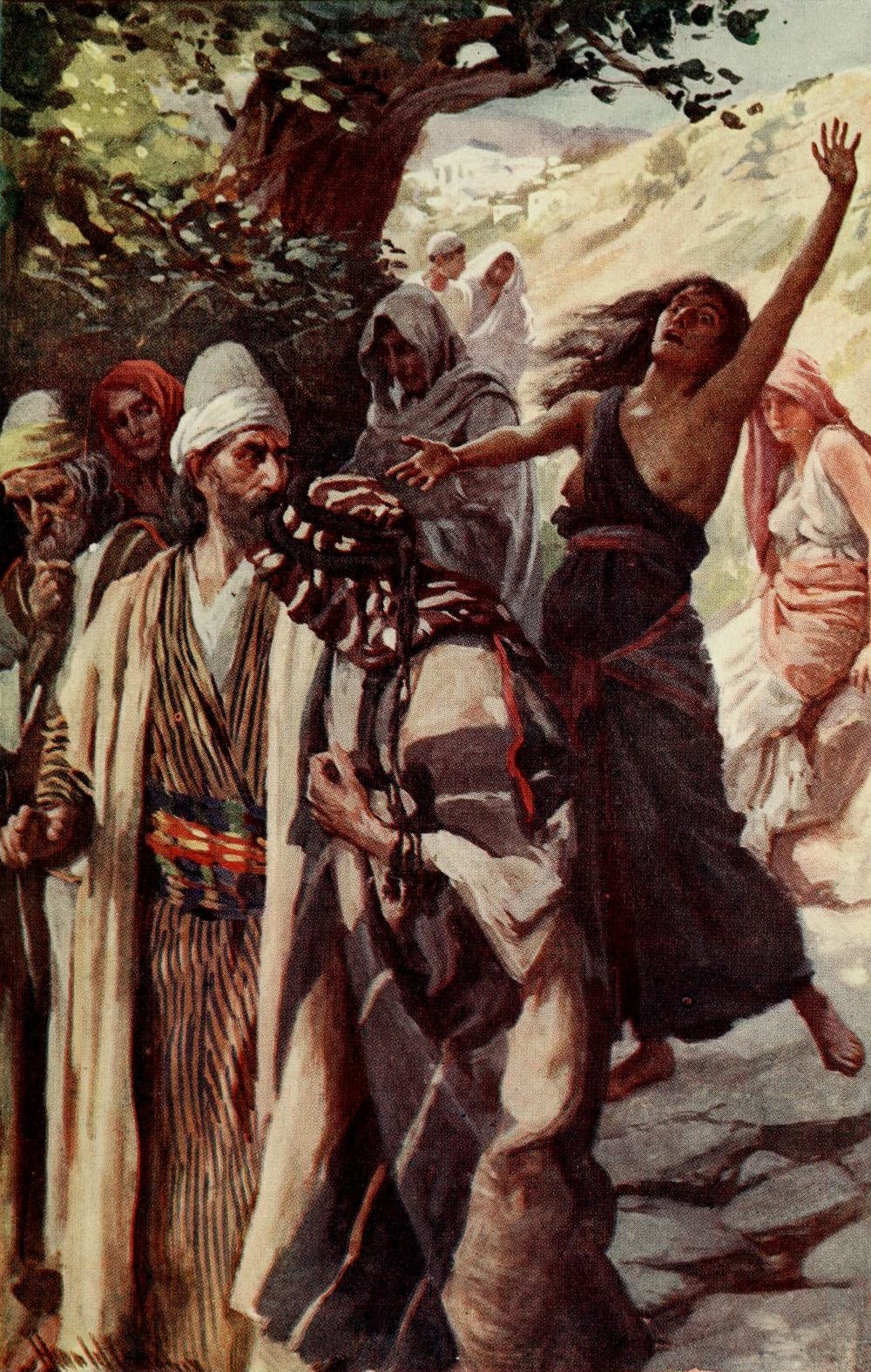
When it comes to interpreting this passage, I think that the pivotal question is “What motivated Paul to exorcise the enslaved woman?” If we were only to look at what the woman’s public utterances—“These men are slaves of the Most High God, who proclaim to you the way of salvation”—the problem does not seem so obvious. There is nothing in her words that contradicts how Paul portrays himself, whether in the narratives of Acts or in his own letters. In the first verse of Romans, Paul identifies himself as a slave (in Greek, doulos) of Jesus Christ. A few verses later, in Romans 1:16, Paul declares that the gospel is “God’s saving power for everyone who believes.” We also know that early Christians were called “the Way.” Everything seems to check out!
The issue is that if we limit ourselves to an analysis of the woman’s speech taken out of context, we are engaging in what an anthropologist might call “thin description.” While our thin description captures behavior on the surface level (i.e. what the woman says), it does not capture the woman’s intentions or her social world. For that, we need to engage in “thick description,” interpreting her behavior within her context.3
In order to provide a thick description of these events, we need to make some important observations about the woman’s social location. The passage describes her as “a female slave who had a spirit of divination and brought her owners a great deal of money by fortune-telling,” which provides us with several relevant details.
First, as a female slave in the Roman Empire, this woman was constantly surrounded by the threat of legally-sanctioned violence. Under Roman culture, enslaved people were viewed as extensions of their enslavers’ bodies, such that the Greek word for body, sōma, came to be used as an euphemism for “slave.” (In fact, in Revelation 18:13, merchants lament that with the fall of Babylon, they no longer have a market for “bodies,” which is to say, human lives!) Under Roman law, all freeborn people had license to insult enslaved people, while enslavers could subject their slaves to physical torture.4 Slaves were subjected to pervasive sexual violence, because the law granted enslavers unrestricted sexual access to their slaves. Female slaves were used as sexual surrogates that would engage in acts that freeborn women considered shameful.5
Furthermore, the text tells us that the woman had a spirit of divination. While women in the Roman world were generally expected to keep silence, one of the accepted avenues for women to speak was through prophecy. For example, the Oracle at Delphi, also known as the Pythia, was thought to deliver prophecies from Apollo.6 This woman’s prophetic possession provided her a socially-acceptable avenue for public speech, which, as an enslaved woman, she might not have had possessed otherwise. However, the text informs us that the woman did not speak purely for her own benefit, because she brought her owners a great deal of money by fortune-telling. This woman could not speak freely, because as an enslaved person in the Roman Empire, she had no legal protections from being tortured or sexually coerced by her enslavers.
Therefore, when we think about Paul’s act of exorcism in this passage, we cannot think about it simply in terms of what the enslaved woman is saying, but we must also consider the fact that ultimately, her speech is controlled by her enslavers. Although the woman is physically capable of all kinds of speech, she is socially constrained by her enslaved status and the omnipresent threat of her enslavers’ violence.
I think these facts are important in light of the fact that she kept doing this for many days. Her utterance, “These men are slaves of the Most High God, who proclaim to you the way of salvation,” was not a one-off event, but a persistent behavior. I assume that although her enslavers would not be constantly monitoring her, they must have had some idea of what she was doing if it took place over several days. It seems clear to me that her enslavers approved of, or at least tolerated, what she was doing, or else they would have stopped her from following Paul for as long as she had. It was only after Paul exorcised the woman that her owners saw that their hope of money was gone. That implies that they still saw a money-making opportunity in what she was doing!
What was that money-making opportunity? I think that it is something like this: By following Paul and repeating his words (e.g. “Paul, a slave of Christ Jesus … I am not ashamed of the Gospel; it is God’s saving power for everyone who believes”) the enslaved woman appropriates Paul’s spiritual authority in the eyes of the public. Through an act of mimicry, the woman positions herself as a spiritual authority in her own right, so that when Paul departs the area (as he inevitably will), she will be able to speak authoritatively to the public in Paul’s absence. I suggest that her enslavers saw this too, and were excited to cash in on her newfound spiritual clout. History has repeatedly proven that unscrupulous people can find enormous money-making opportunities by convincing the public that they control the means of salvation!
Paul, I argue, recognized this potential social dynamic, and prevented it from developing by exorcising the woman. Whether or not you believe in the metaphysical reality of spiritual posession (that is rather outside the scope of this exegesis), I think that what we can agree on is that in ancient Rome, prophetic possession was one of the few social avenues through which an enslaved woman might have recognizable spiritual authority. By publicly exorcising the woman, Paul strips her of this authority, which would be appropriated by her enslavers in order to make money off of her clout.
I think it is also important to note something that doesn’t happen here. Unfortunately, Paul does not do anything to free the woman from enslavement itself, although it does not seem clear to me how Paul could have feasibly accomplished this. The stance of early Christianity towards slavery, as record in the New Testament, is ambiguous at best and there is very little in the New Testament that could be called “abolitionist” in the sense of universally condemning slavery. St. Gregory of Nyssa, who was not only the first recorded Christian abolitionist but also one of the first recorded abolitionists period, lived about two hundred years after the New Testament was written. As I noted in “Why AI ethics needs theological voices,” the Church owes an enormous debt for its complicity with slavery, both in the ancient Mediterranean and in the early modern Atlantic. Scriptures like this call us to account again and again for our moral failings.
So how does what I have written so far apply to the case of AI chatbots? I find that remarkably, many of the same factors are at play. It has become increasingly common for people to seek spiritual support from chatbots, whether through general-purpose foundation models, like GPT and Gemini, or through apps built on top of foundation models. Quite disturbingly, many of these apps are branded with names like “Chat With God” or “Chat With Jesus,” implying that are real channels for the divine!
I think that it should not be necessary for me to argue why they are not, but sadly we live in such times that force me to spell it out. Large language models (LLMs) do not have genuine “world models” when it comes to contrived situation like playing board games, let alone anything as infinitely nuanced as providing spiritual care. Melanie Mitchell’s newsletter, AI: A Guide for Thinking Humans lays out the case here:

A Christian theological perspective that helps make sense of this is the distinction between ratio (“reason”) and intellectus (“intellect”). Humans are capable of “reasoning” in the sense of the discursive, analytical problem solving (e.g. the kind that you would do in a math class or in a philosophy class), but they also have “intellect” in the sense of having an intuitive grasp of the truth. I think that the idea of “world models” in the field of machine learning is not so far from intellectus.7 The evidence suggests to me that large language models fall short of humans in both ratio and intellectus, neither having world models nor humanlike abstract reasoning capabilities:
So what are LLMs good at, then? Well, just like the enslaved woman at Philippi, it turns out that they are extremely good at repeating what others have said in novel ways. Good enough, apparently, for some people to assign them spiritual authority! We now know of several cases of AI psychosis, in which AI chatbots have encouraged their users’ spiritual delusions, including some cases that have resulted in violence.
Already we are in a very dire situation, but I think that something that makes the situation even worse is that it could be potentially very easy for the developer of a spiritual companionship app to manipulate the output by adjusting the system prompt. Let’s say that I was a cult leader, and I wanted to manipulate more people into joining my cult. What if I created a spiritual companionship app, which at first behaves like any other spiritual companionship app (as dubious as those are), but once I have attracted a long-term user, I modify the system prompt to make the underlying LLM indoctrinate them into my belief system and encourage them to join my cult? As with the case of the woman in Philippi, an external authority is pulling the strings.
If this sounds unbelievable to you, just consider how Elon Musk has clearly been manipulating Grok’s system prompts to shape its output, resulting in it calling him fitter than LeBron James or mentioning “white genocide” in replies to unrelated queries. Although this is clearly a terrible and dangerous thing to do, I think that the damage is somewhat limited here by the total lack of subtlety in Musk’s approach. But could you imagine what kinds of damage an experienced spiritual abuser could do with a more subtle approach, if they had control over an AI companion app, which had a userbase that was psychologically dependent on it for spiritual support?
What can I even say? We are in extremely dangerous waters. Discourage anyone you know from using AI for spiritual support. Cast out these fortune-telling spirits!
Matthew 4:4.
St. Augustine, On Christian Doctrine, ed. Phillip Schaff, trans. J. F. Shaw, A Select Library of the Nicene and Post-Nicene Fathers of the Christian Church 2 (Eerdmans, 1956), http://archive.org/details/aselectlibraryof02unknuoft.
Clifford Geertz, “Thick Description: Toward an Interpretive Theory of Culture,” in The Interpretation of Cultures (Basic Books, 1973), https://philpapers.org/archive/geettd.p.
This is depicted in the Parable of the Unforgiving Servant (Matthew 18:23–35).
For more about slavery in the Roman Empire, especially as it relates to early Christianity, see Jennifer A. Glancy, Slavery in Early Christianity, expanded ed. (Fortress, 2024).
Susan E. Hylen, “Speech and Silence,” in Women in the New Testament World (Oxford University Press, 2018), https://doi.org/10.1093/oso/9780190237578.003.0007.
For more on this, see Dicastery for the Doctrine of the Faith and Dicastery for Culture and Education, “Antiqua et Nova: Note on the Relationship Between Artificial Intelligence and Human Intelligence,” January 28, 2025, https://www.vatican.va/roman_curia/congregations/cfaith/documents/rc_ddf_doc_20250128_antiqua-et-nova_en.html.