

Losing the plot
An essay in which I interpret both Zoom church and Leo Tolstoy

Welcome to AI and Our Faith! This is a monthly newsletter in which I offer my best insights and reflections on the ways in which theological thinking can inform the ethical (dis)use of artificial intelligence (AI). Look out for new releases on the 15th of each month!
Recent events in my life have got me thinking about the phenomenon of “Zoom church,” i.e. the practice of watching church services live over Zoom (or other kinds of videoconferencing software). One of the enduring legacies of the Covid pandemic is that many churches continue to offer livestream services over Zoom. If the technologies we use affect our narrative understanding of the world, as I argued in last month’s essay, “Work can be joyous,” how does Zoom shape us as worshippers?

One of the ideas that I have found most helpful for thinking about technological ethics in a religious context is Wessel Reijers and Mark Coeckelbergh’s theory of technological emplotment. The idea behind this theory is that technologies like Zoom are similar to narrative texts like novels and films on some level. When we use or “read” a technology, we organize characters (i.e. users) and events into a meaningful whole (i.e. a plot). These technological “plots” thus reshape our idea of the world.1
I suspect that many of my readers will find this interpretation of technology, based in the philosophy of Paul Ricoeur, somewhat implausible or strained. To be honest, I had a very hard time grasping this concept myself until I tried applying it to real-world scenarios. In this essay, I’ll walk through Reijers and Coeckelbergh’s theory of technological emplotment and apply it to the case of Zoom as a worship technology.
But, before I get to talking about Zoom, I need to explain what Reijers and Coeckelbergh mean by “emplotment,” and how stories reshape our worldviews. In order to do so, I will turn to a story about a man who reads a life-changing story: “Where Love Is, God Is” by Leo Tolstoy. (Yes, here I am writing about Tolstoy again!)
It is the story of a cobbler named Martin, who falls into despair, “so great and overwhelming that he murmured against God,” after the death of his wife and his eleven children, including his only son, a three-year-old. Nevertheless, he regains his sense of life’s meaningfulness when he happens to encounter a pilgrim, who explains to Martin that he should learn how to live his live for God by reading the Gospels. Thus, the pilgrim’s words “sank deep into Martin’s heart, and on that same day he went and bought himself a Testament in large print, and began to read.”
“At first he meant only to read on holidays, but having once begun he found it made his heart so light that he read every day. Sometimes he was so absorbed in his reading that the oil in his lamp burnt out before he could tear himself away from the book. He continued to read every night, and the more he read the more clearly he understood what God required of him, and how he might live for God. And his heart grew lighter and lighter. Before, when he went to bed he used to lie with a heavy heart, moaning as he thought of his little Kapitón [his son]; but now he only repeated again and again: ‘Glory to Thee, glory to Thee, O Lord! Thy will be done!’”
One night, as he is reading the Gospels, Martin comes across Luke 7:36–50, in which a woman “who was a sinner” bathes Jesus’s feet with tears, dries his feet with her hair, kisses his feet, and annoints them with precious ointment. Martin is struck by the way Jesus that reproaches Simon, the Pharisee who invited Jesus into his house: “Seest thou this woman? I entered into thine house, thou gavest me no water for my feet: but she hath wetted my feet with her tears, and wiped them with her hair. Thou gavest me no kiss; but she, since the time I came in, hath not ceased to kiss my feet. My head with oil thou didst not anoint: but she hath anointed my feet with ointment.”
Martin then muses, “He must have been like me, that Pharisee. He too thought only of himself—how to get a cup of tea, how to keep warm and comfortable; never a thought of his guest. He took care of himself, but for his guest he cared nothing at all. Yet who was the guest? The Lord himself! If he came to me, should I behave like that?”
Soon afterwards, Martin falls asleep, and in the night he hears a voice saying to him, “Martin, Martin! Look out into the street tomorrow, for I shall come.” After waking up the next day, Martin looks expectantly into the street from his window, believing that he might have actually heard a message from Christ himself. Throughout the day, Martin sees nothing out of the ordinary, but he does notice three sets of his neighbors who need his help: a retired soldier named Stepánitch, a single mother and her child, and an old woman selling apples who fights with a young boy over a stolen apple. In each case, Martin does something to show love for his neighbors: he invites Stepánitch into his house and offers him hospitality; he feeds and clothes the single mother and her child; and he interrupts and diffuses the conflict over the stolen apple.
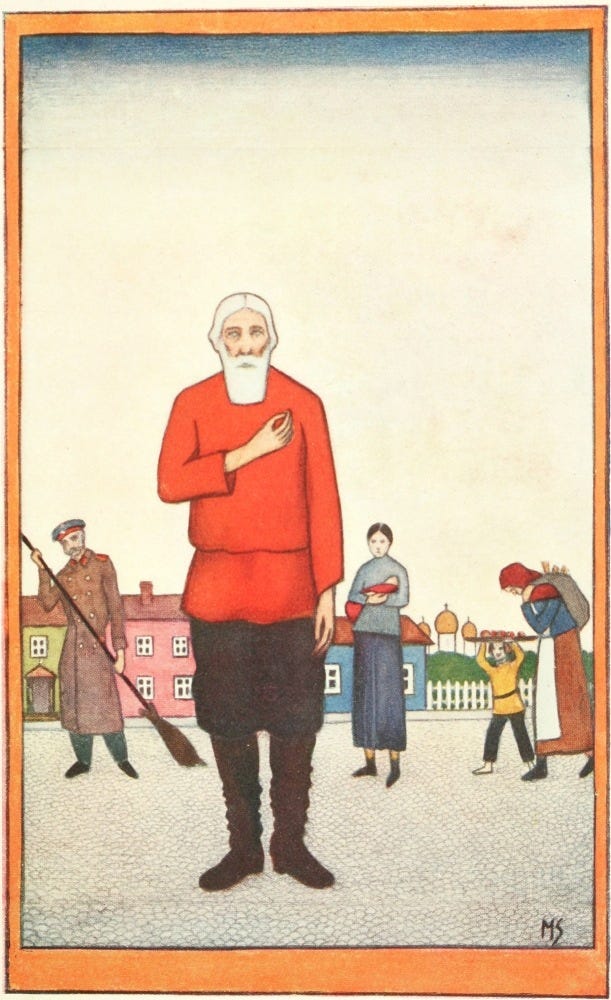
As night falls and Martin prepares to read, Martin has a vision of the people who he helped that day appearing to him in the darkness. Then, turning to the Gospel book, he finds that it is opened to Matthew 25:31–46, and reads, “I was an hungred, and ye gave me meat: I was thirsty, and ye gave me drink: I was a stranger, and ye took me in. … Inasmuch as ye did it unto one of these my brethren, even these least, ye did it unto me.” The story thus concludes: “And Martin understood that his dream had come true; and that the Saviour had really come to him that day, and he had welcomed him.”
How does Paul Ricoeur’s model of emplotment operate within the plot of “Where Love Is, God Is”? Emplotment begins with a prefigurative phase, in which the reader of a narrative brings in their previous understanding of the world as they encounter a text. In “Where Love Is, God Is,” Martin has a certain understanding of ideas like “Christ,” “love,” and “neighbor” before he begins to read the Gospels (which are, after all, narrative accounts of Christ’s life, ministry, and redeeming work). Emplotment then enters the configurative phase, in which the reader organizes characters and events into a meaningful whole (i.e. a plot). When Martin reads Luke 7:36–50, he develops a mental model of characters like Jesus, the Pharisee, and the woman, fitting their interactions into a plot. Finally, emplotment concludes with the refigurative phase, in which the reader’s process of engaging with the plot transforms their previous (i.e. prefigured) understanding of the world. When Martin reads Matthew 25:31–46 and concludes that Christ had really visited him, and that he had welcomed Christ, Martin arrives at a new understanding of the concepts of “Christ” and “neighbor,” because he comes to see that whatever one does to the least of their neighbors, they also do to Christ.
I think that the literary genius of “Where Love Is, God Is” lies in this: by depicting the process of emplotment transforming a fictional character (Martin)’s life, we are invited to allow the same process of emplotment to transform our own lives. How can we be more like Martin, eagerly peeking outside our windows and responding to the suffering of our neighbors with open and generous hearts? A beautiful message, but more difficult to implement in practice than it is in theory—and yet we must try.
At this point, I would like to return to the idea of technological emplotment. I think that Reijers and Coeckelbergh provide an incredible conceptual tool for thinking about technology when they invite us to think about technology in narrative terms. Their argument is that, like written narratives, technologies invite us to organize our experiences into plots, and these plots thus reshape our understanding of the world.
This idea may not seem very convincing without a concrete example. Let us turn to the situation which opened this essay: the phenomenon of Zoom church. Before someone ever opens up Zoom in order to participate in a livestreamed service, they will have certain understandings of concepts like “church,” “worship,” “liturgy,” etc. These preexisting notions correspond to the prefigurative phase of emplotment. A person who has never encountered video conferencing technology (i.e. the vast majority of Christians who have ever lived) would assume that worship involves meeting at certain physical locations at certain times and engaging in certain ritually-prescribed actions with our whole bodies. So this might look like going to a church building on every Sunday morning, singing hymns out loud, partaking in Communion, etc.
When this person uses Zoom in order to attend church for the first time, they are invited, by necessity, to form plots about what they are doing. (As Stephen Crites argues, consciousness itself has a narrative quality. As embodied humans, we can’t be conscious without constructing narratives about our experiences.)2 Thus, as we use Zoom as a worship technology, we are invited to form plot points that encompass our experiences, like “I am attending church over Zoom,” “I am worshipping over Zoom,” “I am participating in worship along with so-and-so,” etc. The development of this plot corresponds to the configurative phase of emplotment. What I want to argue is that by developing this plot about worshipping over Zoom, the Zoom user’s idea of what it means to worship (and, ultimately, to be a Christian) is shaped in subtle ways. The idea of worship becomes less communal and embodied, because there is no longer a sense of having to be in a particular place at a particular time. By celebrating Communion over Zoom, churches reshape the very understanding of Communion.
I don’t want anyone reading this essay to think that I am arguing that Zoom church is something inherently bad. As we saw during the Covid pandemic, Zoom church enabled people to participate in religious life at a time when large in-person gatherings would not harmonize with love for our neighbors. Zoom church allows people who are homebound, immunocompromised, or simply have the flu to be included in the life of the church. At the same time, I think it’s important for churches to be conscious of the fact that using Zoom as a worship technology makes, on some level, implicit statements about theology and the nature of religious worship. Unless churches engage with the concept of technological emplotment and critically reflect on their use of worship technologies, they risk losing the plot entirely. We also shouldn’t forget that Zoom and other technologies like it are products of the modern capitalist workplace. As such, they embody its logic of productivity and multitasking. What might it mean to develop alternative worship technologies that center the values of Christian worship: reverence, love of neighbor, deep attention, etc.? We will never know unless we scrutinize our technologies as much we would our theologies.
Wessel Reijers and Mark Coeckelbergh, Narrative and Technology Ethics (Springer, 2020), 81–89, https://doi.org/10.1007/978-3-030-60272-7.
Stephen Crites, “The Narrative Quality of Experience,” Journal of the American Academy of Religion XXXIX, no. 3 (1971): 291–311, https://doi.org/10.1093/jaarel/XXXIX.3.291.
Well done!